
When you order custom roller shades from EcoSmart Shades, you choose your fabric, provide your window measurements, and wait for your new shades to arrive. But what happens between placing your order online and opening that box?
At EcoSmart Shades, we manufacture custom roller shades for both residential and commercial spaces. While roller shades might look relatively simple, there’s quite a bit that goes into making sure each one fits your windows and operates the way it should.
From cutting the fabric to assembling the components, our shade builders prepare each roller shade according to the specifications of the individual order.
We’re taking you behind the scenes at our Williston, Vermont, facility to show you how custom roller shades are made. Let’s get into it!
Step 1: Cut the Rails and Tubes
The first step in making a custom roller shade is preparing the hardware.
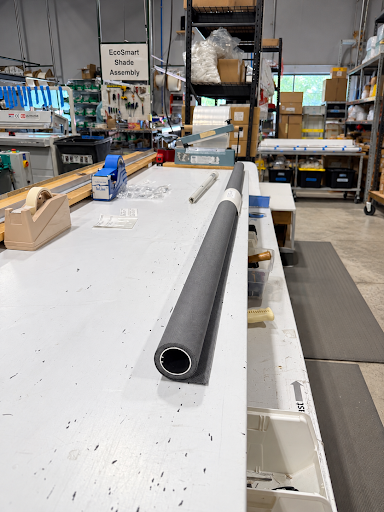
Unlike cellular shades, which use a honeycomb-shaped fabric that expands and contracts, roller shades operate by winding a flat piece of fabric around a tube. That tube is one of the most important components of the finished shade, because it’s what allows the fabric to roll up neatly when you raise the shade and unroll when you lower it.
Our shade builders begin by cutting the tubes and rails to the appropriate dimensions based on the measurements provided with each order. Because our roller shades are made to order, these components need to be sized specifically for the windows they’ll eventually cover. Once the hardware has been cut, it’s time to move on to the fabric.
Step 2: Cut the Roller Shade Fabric
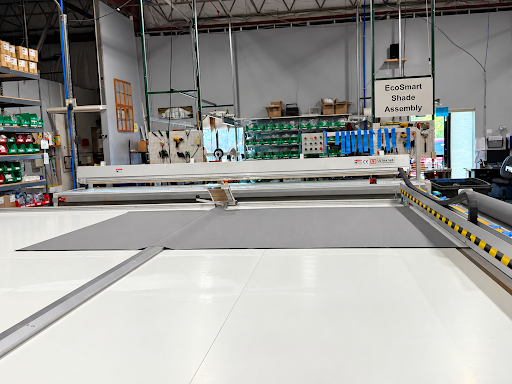
Next up is the part of the shade you’ll see the most: the fabric!
This is where the manufacturing process for roller shades differs quite a bit from the process for cellular shades (you can learn more about how our cellular shades are made here).
When we manufacture custom cellular shades, we cut the fabric for one shade at a time. With roller shades, however, we can cut fabric for multiple shades at once.
Why the difference? A big part of it comes down to minimizing fabric waste.
By planning how multiple pieces of roller shade fabric will be cut from the same material, our production team can make more efficient use of the fabric rather than cutting each piece individually. This is particularly useful when producing roller shades for larger orders, including commercial projects that may require shades for many windows.
Of course, efficiency doesn’t mean sacrificing customization. Each piece still needs to be cut to the dimensions specified in the individual order.
Once the fabric has been cut, we have the main materials needed to start putting the shade together.
Step 3: Assemble the Roller Shade
Now it’s time to turn those individual components into a finished roller shade.
Although we offer different roller shade styles and operating options, the basic construction remains largely the same.
Most roller shades consist of three primary components:
- The tube: The component at the top of the shade that the fabric rolls around.
- The fabric: The material that covers the window and provides the desired level of light control and privacy.
- The hem bar: The component installed along the bottom edge of the fabric to provide weight and help the shade hang properly.
Our shade builders bring these components together, attaching the fabric to the tube and installing the hem bar at the bottom.
The hem bar might seem like a small detail, but it plays an important role in the finished product. By adding weight to the bottom of the fabric, it helps the shade hang evenly as it moves up and down.
Depending on the style and operating system selected, additional components are incorporated into the assembly. And just like that, the individual pieces start to look like the roller shade you’ll eventually install in your home or business!
Step 4: Hang and Test the Shades
Before they’re ready to ship, many of our custom roller shades go through an additional quality-control step.
Our production team hangs and tests approximately 50–60% of the roller shades we manufacture.
This is a little different from our cellular shade production process, where every finished shade is hung and tested. When a roller shade is hung for testing, our shade builders can check how the fabric hangs and how the shade operates, such as: does the fabric roll up properly? Does the shade hang as expected? Are the components functioning the way they should?
These are the kinds of things we want to catch before a shade makes its way to its final destination. After all, the goal is for your new roller shades to fit your windows and work properly from the moment they’re installed!
Step 5: Pack It Up and Send It Your Way
Once assembly and any applicable testing are complete, it’s time to get the finished shade ready for shipping.
But… there’s more to packing a custom roller shade than simply putting the shade in a box! Our team also needs to make sure the appropriate parts and accessories are included with the order.
Depending on the shade’s configuration, that might include mounting hardware, operating components, and other accessories needed for installation.
For motorized roller shades, we also make sure the appropriate motor and related components are accounted for. Since every order is a little different, the contents of each package depend on the shade’s specifications and selected options.
Once everything is ready, the shade is packaged and prepared to make its way from our facility in Williston, Vermont, to its new home: yours!
And there you have it! What looks like a relatively simple window covering actually involves several steps, from cutting the tubes and fabric to assembling the shade and preparing it for shipping.
Whether we’re manufacturing a single roller shade for a bedroom or producing multiple shades for a commercial project, the process starts with the measurements and specifications of the individual order.
That’s what makes custom window shades different from the ready-made options you might find on a store shelf.
Now that you’ve seen how our custom roller shades are made, why not take a look at the finished product?
Explore our selection of custom roller shades to find the right fabric, light control, and operating options for your home or business.